
Farce, Again?
Some preliminary thoughts on the US-Israeli strikes on Iran

Hours after Oman’s foreign minister announced significant progress in the Geneva talks, while both delegations were still exchanging proposals, the bombs fell. The timing is not a detail. Trump did not exhaust diplomacy. He interrupted it, at a moment when both sides were still at the table, because his administration had spent months unable to resolve a basic contradiction at the heart of its Iran policy: whether it wanted to modify the Islamic Republic’s behavior or end the Islamic Republic’s existence. These are not variations on the same goal. They require different strategies, different definitions of success, and different relationships to negotiation, and the Trump administration’s failure to choose between them coherently meant that each position undermined the other until the violence filled the space where a policy should have been.
On the Israeli side, the calculus was simpler and considerably more purposeful. Benjamin Netanyahu has governed for years through the management of permanent crisis, holding together a coalition of maximalists whose political survival depends on the continuation of regional conflict, and he has understood for some time that an Iran reduced to rubble serves his domestic position as directly as it serves Israeli strategic doctrine. His specific contribution to the prevailing ideology of this intervention has been to push the regime-change argument to its most aggressive conclusion: that the destruction of Iranian power is the precondition for every other political possibility in the Middle East, a claim that collapses the distinction between Israeli strategic interest and universal human good in exactly the way American neoconservatives collapsed it in 2003. The intellectual architecture is identical. So are its characteristic blindnesses. What the convergence of Trump’s incoherence and Netanyahu’s purposefulness produced was a war that neither could have launched alone, for reasons that neither has stated honestly in public.
The comparisons to 2003 are instructive, though not quite in the way people usually mean them. Marx’s observation that history repeats itself, first as tragedy and then as farce, requires modification when applied to American military intervention in the Middle East. 2003 was not tragedy in any uncontaminated sense, because the Bush administration’s project carried its own farcical elements from the very beginning: the manufactured intelligence, the exile networks feeding fantasies to officials who were grateful for confirmation of what they already wished to believe, the de-Baathification decree that a proconsul signed after spending weeks in the country, dissolving in a stroke the only institution capable of maintaining basic order. If there was tragedy in Iraq, it belonged to the Iraqis who died and were displaced and who have spent the two decades since living with the consequences of a liberation they did not request. America brought the borrowed language of world-historical purpose, retrofitted to cover an agenda of regional dominance. What America and Israel are bringing to Iran now is the same apparatus, reassembled after the conviction that once animated it has drained away entirely, running on institutional habit alone. The exiled prince is in position. The liberation rhetoric is running. Nobody sounds as though they quite believe it.
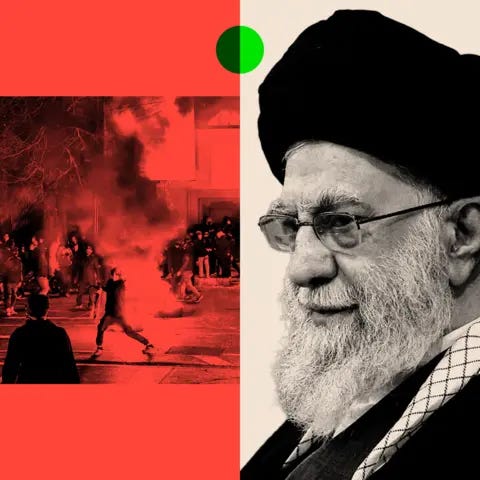
As of this writing, the war has produced what its architects will present as its central achievement. Ali Khamenei, Supreme Leader for thirty-five years, is reported dead, killed in the strikes alongside the IRGC commander, the defense minister, and much of the regime’s senior security leadership. Iranian state media has said nothing, which is itself a kind of confirmation, because governments do not go silent about their leaders unless the news is unmanageable. Trump has celebrated on Truth Social. Netanyahu speaks of growing signs. The machinery of the day after, such as it is, has lurched into motion.
It is here that a certain kind of analysis tends to go wrong. The prevailing grammar of anti-imperial critique has a habit of allowing the indictment of external aggression to crowd out the indictment of internal tyranny, as though the two were in competition rather than in parallel. They are not. The Islamic Republic was not authoritarian in some ambient, catch-all sense. It built its durability on the systematic destruction of Iranian civil society: the mass execution of political prisoners in 1988, carried out on Khomeini’s direct order and numbering in the thousands; the routine imprisonment of journalists, lawyers, labor organizers, and women who refused the veil; the killing of hundreds of protesters in 2019, and again with extraordinary and deliberate ferocity from January through February of this year, when investigations suggest that security forces killed as many as thirty thousand people across two days alone. These were not the excesses of a system under pressure. They were the system’s operating logic, the mechanism by which it reproduced itself across generations, and Khamenei presided over all of it with a theological self-assurance that made accountability, internal or external, structurally impossible. The Iranians who filled the streets in recent months were in revolt against all of this. Their anger was legitimate. Their courage was extraordinary. It answers nothing about whether what is now happening in their name will serve their interests.
To say this clearly is not to endorse the intervention. It is to refuse a false choice. One can believe the regime deserved to fall and still believe this war is a disaster in the making. Both things are true, and the refusal to hold them simultaneously - whether by softening the indictment of Trump’s reckless handling of this war or by allowing the indictment of the theocracy to launder the intervention’s motives - is the only form of dishonesty this moment does not permit.
Khamenei’s death will be celebrated in parts of Tehran tonight, and that celebration will be genuine and earned. It will not resolve the central problem that neither Washington nor Tel Aviv has seriously addressed. The Islamic Republic’s durability was never primarily a function of Khamenei’s personal authority. It rested on the institutional architecture that the regime built around and beneath him: the Revolutionary Guards, whose enterprises control an estimated third of the national economy and whose officer class has the organizational coherence and material interest to outlast any government above them; the clerical networks and foundations woven into the judiciary, the banking system, and the energy sector in ways that no air campaign reaches and no exile government inherits ready-made. The offer of immunity that Trump extended to the Guards before Khamenei’s body was cold was the clearest signal that Washington understands this perfectly well, because immunity is what you offer to an institution you cannot defeat. The most probable outcome of this war is not liberation but reorganization: the Guards reconstituting authority under new management, shedding the clerical superstructure while retaining everything that made the system durable, with the additional legitimacy of having survived a foreign assault.
The Iranian people deserve a future equal to their courage, constructed through their own political agency rather than delivered from outside by powers whose interest in Iranian freedom has been, across every iteration of this relationship, instrumental and finally self-serving. That the regime which denied them that future for forty-seven years was genuinely monstrous does not make the intervention that destroyed it genuinely liberating. Both things are true. And holding them together - unflinchingly, without allowing one to cancel the other - is the only honest place from which to think about what has just begun.
This is a really smart and thoughtful analysis
Man. Wonderful.